
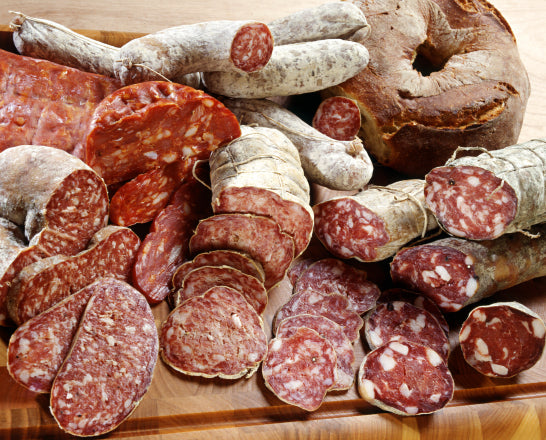

Description
Downloads are available directly below the "Add to Cart" button, free of charge.
The history and production of raw sausages: From tradition to modern processing
Raw sausages are among the oldest foods known to humankind. This unique category of sausage is characterized by its long shelf life and intense flavor. Popular varieties such as salami, pepperoni, and Landjäger have a fascinating history and are globally prized specialties. Learn more here about the origins and production of raw sausages, as well as the importance of starter cultures in modern production.
The history of raw sausages
The origins of raw sausage date back to antiquity. Thousands of years ago, people were already searching for ways to preserve meat. The combination of salting, drying, and smoking proved ideal for keeping meat edible for extended periods.
salami
Salami originated in Southern Europe, particularly in Italy. Its name derives from the Italian word "salare" (to salt). Originally, salami was a simple method of preserving meat through drying and fermentation. It quickly became a popular specialty, which is still produced in numerous variations today – from spicy Hungarian salami to refined fennel salami.
Pepperoni sticks and Landjäger
These smaller raw sausages originated as provisions for hunters and travelers. Thanks to their firm texture and robust flavor, they were ideal for on the go. Pepper sausages are characterized by their piquant taste, enhanced by black pepper and paprika, while Landjäger are traditionally mild and slightly smoky.
How are raw sausages made?
The production of raw sausages is a precise process that requires experience and care.
1. The ingredients
The base for raw sausages is raw meat, usually pork or beef, combined with fat. The quality of the ingredients is crucial, as it influences the taste and shelf life. Spices such as salt, pepper, garlic, paprika, or fennel provide the characteristic flavor.
2. Chopping and mixing
Depending on the type of sausage, the meat is coarsely or finely minced. It is then mixed with fat and spices. Often, a specially formulated blend is used to achieve the desired flavor.
3. Use of starter cultures
Modern raw sausage production often relies on starter cultures. These natural microorganisms, mostly lactic acid bacteria, promote fermentation and improve shelf life. They ensure that the raw sausage develops its typical acidity and unique aroma.
4. Filling and Tires
The finished mixture is filled into natural or artificial sausage casings. The sausages then undergo a ripening phase, which can last several weeks or even months, depending on the variety. During this time, the sausage dries slowly and develops its characteristic aroma.
5. Smoking and drying
Many raw sausages, such as pepperoni or Landjäger, are smoked. This not only gives them a distinctive flavor but also helps preserve them. Others, like classic Italian salami, are air-dried exclusively.
The role of starter cultures
Starter cultures play a crucial role in the modern production of raw sausages. They ensure controlled fermentation, which not only improves the flavor but also increases product safety. The formation of lactic acid suppresses the growth of unwanted microorganisms, making the sausage more stable and giving it a longer shelf life.
Starter cultures have also made it possible to produce traditional sausage varieties more consistently and on a larger scale, without sacrificing their characteristic taste.
Raw sausages in a modern context
Raw sausages are not only traditional foods, but also an integral part of modern cuisine. Whether as a snack, like pepper sticks, on a cold cuts platter, or as a refined delicacy, like air-dried salami – raw sausages impress with their versatility.
Modern versions also experiment with exotic spices, new ingredients such as game meat or vegetarian alternatives to make the experience even more diverse.
Conclusion: Raw sausages – where tradition meets innovation
The history of raw sausages shows how closely tradition and craftsmanship are intertwined. From simple provisions to gourmet specialties, raw sausages have undergone an impressive evolution.
The combination of traditional knowledge and modern techniques, such as the use of starter cultures, has contributed to the fact that raw sausages are now produced in the highest quality and variety. Whether classic or innovative – raw sausages are a true highlight for gourmets worldwide.
Search terms: History of raw sausage, salami production, pepper stick production, raw sausage starter cultures, raw sausage tradition.
Payment & Security
Your payment information is processed securely. We do not store credit card details nor have access to your credit card information.